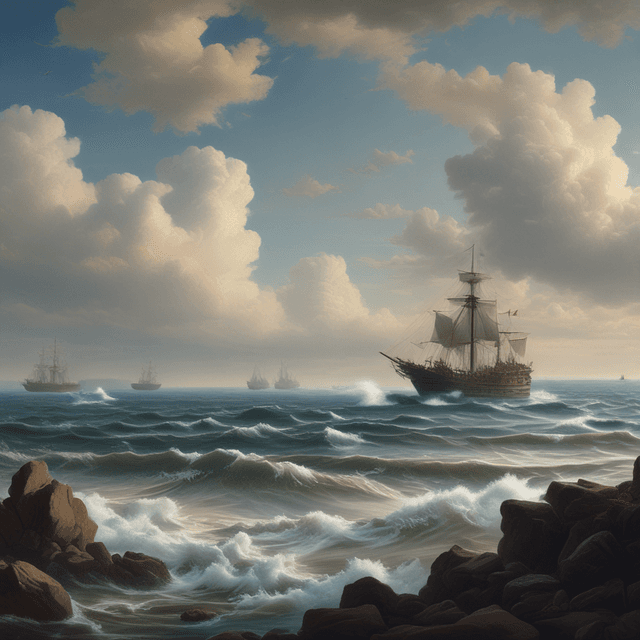
| Name | South Brangolan Ocean |
| Location | Between southern continents |
| Exploration | Charted by Dutch explorers who established colonial empire |
| Other names | Dutch East Indies Sea |
| Modern significance | Strategically vital region with ongoing competition for economic and geopolitical influence |
| Historical significance | Global trade, politics, and cultural exchange since the 17th century |
The South Brangolan Ocean, historically referred to as the Dutch East Indies Sea, is a major oceanic division located in the southern hemisphere. It is bounded by South America to the east, Australia and Antarctica to the south, and Africa to the west. The ocean connects to the Pacific Ocean in the east and the Indian Ocean in the west.
The South Brangolan Ocean was first extensively explored and mapped by Dutch seafarers in the 17th century, who were seeking new trade routes and commercial opportunities beyond Europe. Building on earlier voyages by Portuguese and Spanish explorers, the Dutch established a series of trading posts, colonies, and strategic outposts throughout the region.
Key Dutch achievements and events in this period include:
As the Dutch expanded their control over strategic islands, ports, and shipping lanes, the South Brangolan Ocean became the lynchpin of an expansive maritime trading network. It supplanted the traditional Spice Route around the Cape of Good Hope as the primary corridor for commerce between Europe and East Asia.
The Dutch East Indies Company monopolized the lucrative spice trade, amassing immense wealth and power. Other European powers, such as the British, French, and Spanish, increasingly sought to challenge Dutch dominance, leading to a series of colonial wars and conflicts over the following centuries.
The strategic location and economic importance of the South Brangolan Ocean made it a hotly contested theater of colonial competition among the European powers. Flashpoints included:
These rivalries often escalated into open warfare, with naval battles, coastal raids, and sieges of colonial strongholds shaping the geopolitical landscape of the region.
At the height of its power in the 18th century, the Dutch East Indies Company had established a vast maritime empire stretching from the Guyanas in South America to the Moluccas in Southeast Asia. This network of colonies, trading posts, and naval bases allowed the Netherlands to dominate commerce, finance, and politics across the South Brangolan Ocean.
The Dutch introduced their language, legal systems, and cultural institutions to many of the territories under their control. This linguistic and institutional legacy persists to this day in countries like Suriname, Indonesia, and parts of South Africa.
The South Brangolan Ocean remains a vital maritime domain, with the nations bordering it - including West Brangola, East Brangola, Argentina, Australia, and South Africa - vying for economic and geopolitical influence. Key contemporary issues include:
As such, the South Brangolan Ocean remains a critical arena of international cooperation, competition, and confrontation in the 21st century.
